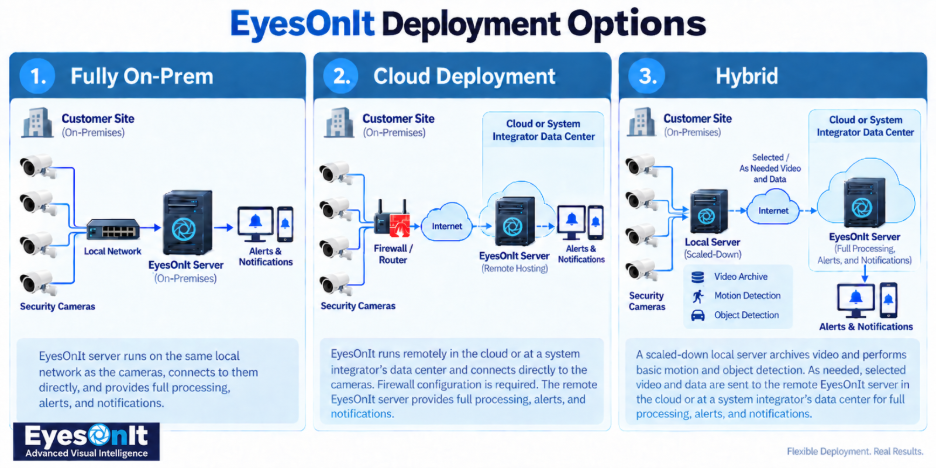
There is no single architecture that makes sense for every video surveillance deployment.
A large enterprise facility with hundreds of cameras may have the infrastructure and processing demand to justify a dedicated AI server on-site. A smaller location may only have a handful of cameras. A system integrator managing dozens or hundreds of customer sites may need an entirely different approach.
That’s why EyesOnIt supports multiple AI video analytics deployment options, including fully on-premises, cloud-hosted, and hybrid configurations.
Instead of forcing every customer into the same architecture, EyesOnIt allows system integrators, VMS providers, and enterprise security teams to choose a deployment model based on camera count, network environment, processing requirements, privacy considerations, and budget.
EyesOnIt is designed to add AI video intelligence to existing VMS and camera environments, including real-time detection, alerts, natural-language video search, and analytics. Its flexible architecture makes it possible to deliver those capabilities across deploymentsfrom individual facilities to distributed multi-site environments.
1. Fully On-Premises AI Video Analytics
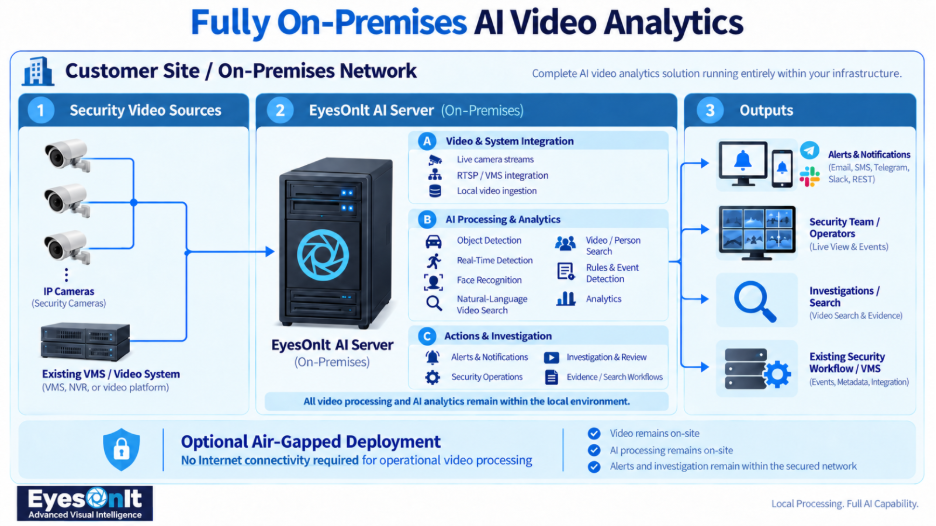
With a fully on-premises deployment, the EyesOnIt server runs on the same local network as the security cameras and connects directly to the camera streams.
Video processing takes place locally, and the EyesOnIt server provides the full set of configured processing, detection, alerting, and notification capabilities.
This architecture can be a strong fit for organizations that:
- Want video processing to remain within the local environment
- Have enough cameras or activity to justify dedicated processing infrastructure
- Have strict network or data-control requirements
- Need consistent local processing performance
- Already maintain servers or GPU infrastructure at the facility
On-premises processing can be especially valuable for security-sensitive environments because video does not need to be continuously transported to a remote processing environment.
EyesOnIt already emphasizes the ability to add AI security camera analytics to existing surveillance infrastructure rather than requiring organizations to replace their cameras or VMS.
For organizations evaluating whether their existing infrastructure is ready for AI, our AI Video Analytics Readiness Checklist covers many of the camera, network, workflow, and infrastructure considerations worth reviewing before deployment.
2. Cloud AI Video Analytics
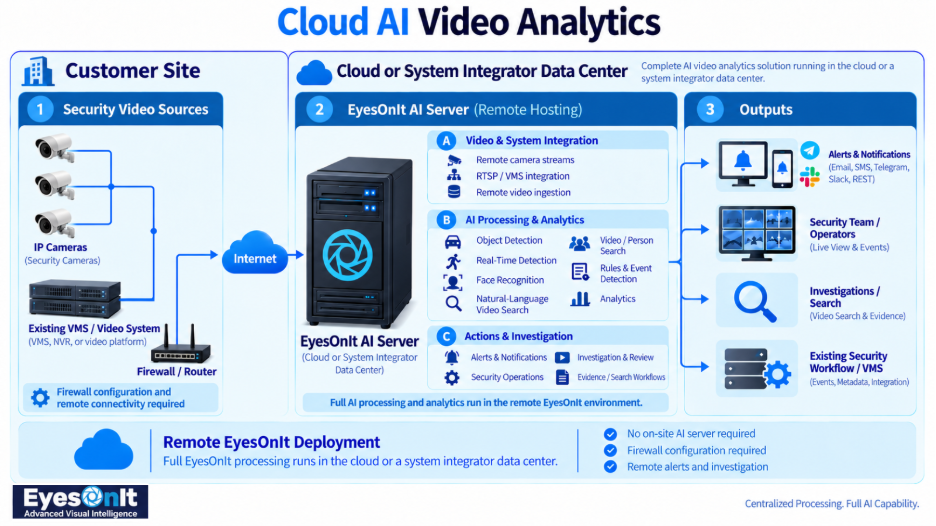
EyesOnIt can also be deployed remotely, with the full EyesOnIt server hosted in a cloud environment or a system integrator’s data center.
In this architecture, cameras remain at the customer location while EyesOnIt connects to the required video streams remotely. The remote server performs video processing and delivers configured alerts and notifications.
Because video must move between the customer network and the remote EyesOnIt environment, appropriate network connectivity and firewall configuration are required.
Firewalls play an important role in controlling traffic between networks with different security requirements, and organizations should incorporate remote video access into their broader network-security policies. The National Institute of Standards and Technology provides additional guidance on firewall technologies and firewall policy.
A remote deployment can make sense when an organization:
- Does not want to maintain a dedicated AI processing server at each site
- Already operates centralized data-center infrastructure
- Wants centralized management of processing resources
- Has reliable connectivity between sites and the processing environment
- Needs to support geographically distributed locations
EyesOnIt works with supported RTSP video environments. RTSP is a standardized protocol designed for controlling delivery of streaming media such as live and recorded video. RFC Editor
3. Hybrid AI Video Analytics
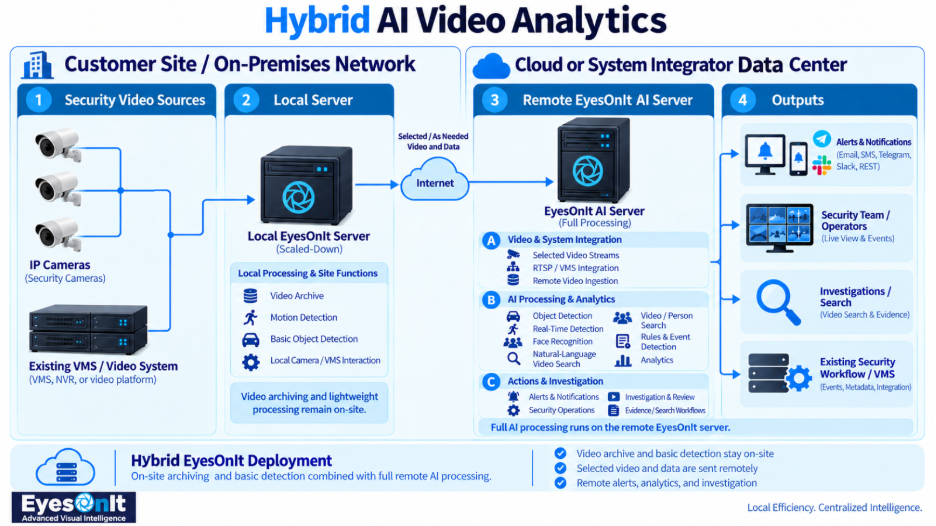
The third option combines local infrastructure with centralized EyesOnIt processing.
With the hybrid deployment model, a scaled-down server is installed at the customer location. Rather than running the complete EyesOnIt processing environment locally, this server handles lighter-weight functions such as:
- Video archiving
- Motion detection
- Basic object detection
- Local interaction with camera streams
The full EyesOnIt server is then hosted remotely, either in the cloud or in a system integrator’s data center.
When deeper AI analysis is needed, selected video and data can be sent to the remote EyesOnIt server for full video processing, detection, alerting, and notification. This creates an important middle ground between installing a full AI server at every site and performing everything remotely.
Why Hybrid Deployment Matters for System Integrators
The biggest advantage of the hybrid model is economics at scale.
Consider a system integrator supporting 50 locations. Installing a complete EyesOnIt processing server at all 50 locations may not make financial sense if many of those sites have only five or ten cameras or very little meaningful activity.
With a hybrid architecture, the integrator can instead deploy a smaller, simpler server at each site and operate one or more full EyesOnIt servers that provide AI processing across multiple locations.
Rather than duplicating expensive processing infrastructure everywhere, centralized processing capacity can be shared. This can significantly reduce the hardware and maintenance cost per location, particularly as the number of customer sites grows. It also gives system integrators another way to package advanced video intelligence for customers that might otherwise be too small to justify dedicated AI infrastructure.
For integrators evaluating deployments with customers, EyesOnIt’s System Integrator Partner resources recommend beginning with the customer’s existing VMS or RTSP environment, camera count, target workflow, and infrastructure before determining the appropriate architecture.
Hybrid Video Analytics Is Especially Useful for Smaller Distributed Sites
Hybrid deployment becomes particularly attractive when an organization has many locations with relatively few cameras at each site.
Examples include:
- Small hotels. A hotel may only need analytics around entrances, parking areas, lobbies, or selected service areas rather than processing hundreds of cameras continuously.
- Bank branches. Individual branches may have relatively modest camera counts while the organization operates dozens or hundreds of locations.
- Convenience stores and gas stations. Each site may only require monitoring around entrances, registers, pumps, parking areas, or restricted spaces.
- Retail stores. A retailer can deploy lightweight infrastructure across stores while centralizing more advanced AI processing.
- Self-storage facilities. Individual facilities may have limited activity during much of the day, making dedicated high-performance processing hardware at every property inefficient.
The same architecture can apply to many other distributed organizations in which the total network is large but each individual location is small. Because EyesOnIt can support capabilities such as natural-language forensic video search, system integrators can add more advanced video intelligence to these environments without treating every small location like a standalone enterprise deployment.
One Platform, Multiple Deployment Models
Flexible deployment becomes increasingly important as video analytics expands beyond large centralized surveillance environments.
A single system integrator might support a corporate headquarters with hundreds of cameras, twenty retail locations with ten cameras each, and dozens of smaller sites with only a few streams. There is little reason those environments should all require identical infrastructure.
EyesOnIt gives integrators and enterprise customers the flexibility to choose among:
- Fully on-premises: Full EyesOnIt processing at the customer site. Air-gapped processing is available for maximum security in disconnected operations.
- Cloud or remotely hosted: Full processing centralized in the cloud or a system integrator’s data center.
- Hybrid: Lightweight processing and archiving on-site combined with shared remote EyesOnIt processing.
The result is an architecture that can be sized around the actual needs of each location instead of forcing every customer into a one-size-fits-all deployment.
Build the Right EyesOnIt Architecture for Your Environment
Choosing the right deployment depends on your camera environment, network architecture, processing requirements, number of locations, security policies, and planned video analytics workflows.
For organizations with distributed locations in particular, the hybrid approach creates a compelling opportunity: bring AI video analytics to more sites while reducing the hardware and maintenance burden required at each location.
EyesOnIt works with VMS providers, system integrators, and enterprise customers to evaluate existing infrastructure and determine the deployment architecture that makes sense for the application.
Interested in seeing how EyesOnIt could fit into your environment?
Explore EyesOnIt’s AI video analytics capabilities or contact our team to discuss an on-premises, cloud, or hybrid deployment.